

We’ve all heard the cautionary tale: a brilliant clinician-founder spends two years and a small fortune building a “game-changer”… that never gets used. In healthcare, these failures are costly in money and opportunity. Strategyzer’s research puts it bluntly: 7 out of 10 new products fail to deliver on expectations — largely because we build before we test.
Building on our Monday Masterclass on the importance of testing your idea with a MVP and lean experiments in this week’s book club we’re talking about our favourite book on the topic…. read on to see what it is!!
The uncomfortable truth: your plan is a bundle of guesses
Lean Canvas, business cases, TAM slides… helpful, yes. But every box is a hypothesis. The job now is to sort the riskiest ones (the ones that would sink your company if you got them wrong) and turn them into evidence.
For MedTech, those riskiest assumptions usually cluster around:
- Desirability: Will clinicians actually change behaviour?
- Viability: Will an ICB or trust pay (and on what proof of ROI)?
- Feasibility: Can we meet IG and integration constraints in real settings?
- Acceptability: Are we operating within service-evaluation/ethics boundaries and privacy law?
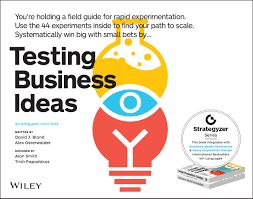
The field guide: Testing Business Ideas (Bland & Osterwalder)
This is the most practical playbook I’ve found for turning assumptions into data. The book’s Experiment Library covers 44 concrete tests you can run… from fake-doors and explainer videos to concierge and Wizard-of-Oz MVPs.
Two modes matter:
- Discovery experiments: fast and cheap, to learn where value really is.
- Validation experiments: stronger tests (often with time/money commitment) to confirm you’re onto something.
A helpful cadence is to aim for one experiment a week (eg. “12 experiments in 12 weeks”) to keep momentum and build a real evidence trail.
Medtech-specific examples (with guardrails so you don’t get into trouble!)
1) Fake-door landing page (Discovery)
Spin up a simple page for your proposed software/device with a clear CTA (“Join our pilot waitlist”). Drive targeted traffic (LinkedIn, clinical forums). Treat verified sign-ups as your proof point, behaviour beats opinions.
Guardrails: If you’ll touch real patient data later, note that a DPIA is expected before processing; keep the landing test strictly non-clinical.
2) Concierge MVP (Validation)
Deliver the promised value manually (clinician-led analysis, white-glove onboarding) behind a simple front-end. You de-risk desirability and workflow fit before building anything complex.
Wizard-of-Oz MVP (Validation)
Present a working UI “front stage”, with a human doing the heavy lifting “back stage” to simulate automation. Great for AI-ish concepts where building the model would be expensive.
Guardrails for 2 & 3: If you test in live care settings, first decide service evaluation vs research (service evaluations don’t need REC approval; research often does). Use the HRA decision tool/Defining Research table and complete a DPIA where personal data is processed.
Three experiments you can run this month
1) Fake Door + Email Capture
Set-up: 1-page site; CTA = “Request a demo / Join pilot”.
- Traffic: 200–500 targeted clinicians via LinkedIn messages or communities.
- Success criteria: ≥3–5% of unique visitors request a demo and ≥50% of those reply to your follow-up.
- Decision: If below threshold, iterate proposition/segment and re-test.
2) Explainer Video (+ CTA)
- Set-up: 60–90s video showing current pain → your solution → clear benefit; host on a landing page with signup.
- Measure: % watch-through and % click/sign-up.
- Success criteria: ≥50% watch-through, ≥5% sign-up from qualified traffic; book calls with the first 10 sign-ups.
3) Wizard-of-Oz Pilot Simulation
- Set-up: Clickable mock (Figma/Slides) + human-in-the-loop for outputs.
- Evidence: Time-on-task, net perceived value (simple “Would you keep this in your workflow?”), and willingness to commit (LOI, pilot sign-off, or paid evaluation).
- Governance: Class as service evaluation where appropriate and complete privacy impact steps before any real data flows.
Build evidence, not opinion
The book leans on a hierarchy of evidence: actions that cost time/money (sign-ups, deposits, LOIs) beat surveys and compliments every time. That’s why Testing Business Ideas pairs beautifully with The Mom Test: interview well to uncover truth, then observe behaviour to prove it. (see our review of the Mom Test here )
Bottom line
In a regulated, resource-constrained system, you can’t afford to build on faith. Testing Business Ideas gives you an NHS-friendly toolkit to learn fast, minimise waste, and answer the only question that matters: are you building something people will use and buy?
Enjoyed this and want more?
Join the Medtech Mentor mailing list by entering your email below and and grab the Founder’s Starter Pack as well as an excellent 10 email series to kick start your progress towards a successful solution
If you want to see our other Masterclass and Book Club posts head to our main blog page here.
Thanks for reading and happy experimenting!!
The Medtech Mentor Team
P.S. we do use affiliate links which means we get a small amount of money if you buy something – this is at no cost to you and we never recommend anything we don’t think is awesome! Thanks for reading!