
So — you’ve got an idea….
Maybe it came to you in clinic. Maybe after running out of patience with another broken workflow or spreadsheet workaround. You can see the solution in your head. It makes sense.
But turning it into something real?
That feels… murky… scary…
And you’re not alone.
Most early-stage founders get stuck before they even start.
Why?
Because the leap from concept to company is full of hidden traps: falling in love with your solution too soon. Skipping over the real problem. Assuming people want what you’ve built (without asking them). It’s easy to lose months, and thousands of pounds(!) building something nobody needs.
Our mentors have supported hundreds of founders through this exact phase. In our course From Idea to Business Model, we guide people from fuzzy concepts to fundable business models — without wasting time, money, or momentum.
This post is a condensed version of that process.
If you’ve ever said, “I’ve got an idea but don’t know what to do next” — this one’s for you.
Step 1. Start with the Problem
This might sound obvious, but it’s the step most people skip — especially if they’re excited about a particular solution. It’s so tempting to build first and ask questions later.
Users and customers in healthcare?
Your user and your customer are often not the same person. The doctor might use your product, but the commissioner pays for it. You’ve got to solve a real problem for both of them. Otherwise it won’t scale. Full stop.
Avoid ‘the Hammer Paradox’: you’ve built a hammer and now every problem looks like a nail. When you have build a clever solution, you can end up bending the problem to fit your hammer — instead of figuring out what tool is actually needed.
Pro Tip: Before you sketch a logo or talk to a dev, speak to real people. At least 10 users and 5 customers. Ask them what’s broken, what they’ve tried, and how they really feel about it.
Try this:
- Define the problem in a single sentence.
- List 2–3 types of users and customers.
- Interview each group. Record what you learn.
- Look for the workarounds — that’s where the gold is.
Step 2. Think Holistically — Draft a Business Model
A business model isn’t just “how you’ll make money.”
It’s how all the moving parts connect: who you’re serving, what value you offer, how you’ll reach them, how it’ll run.
Tech, IP, regulation — they’re important. But if you don’t understand your market or your customer, you’re building in the dark.
Pro Tip: Use a Lean Canvas. One page. Fast clarity.
Try this:
- Fill out a Lean Canvas (step by step guide for this available in our starter pack).
- Challenge every box. Is it a fact or an assumption?
- Pay attention to channels (how people find you) and costs (how much it’ll take to stay alive).
Step 3. Find Your Riskiest Assumptions
Every idea sits on a pile of assumptions.
Some are harmless. Others are make-or-break.
You need to uncover the Leap of Faith Assumptions (LOFAs) — the ones that, if you’re wrong, sink the whole ship.
Most early-stage risks sit in four areas:
- Problem — is it painful enough that people will pay for a fix?
- Customer — are you speaking to the actual buyer?
- Solution — does it actually solve their problem?
- Unique Value Proposition — why you over the rest?
Pro Tip: Write down your top 3 assumptions. Then ask: how could I test this today, without building anything?
Try this:
- List your LOFAs and rate them by risk/uncertainty.
- Design super simple tests: surveys, landing pages, mock sales calls.
- Log what you learn and adjust your business model.
Step 4. Define Your MVP
Your Minimum Viable Product isn’t your final product.
It’s the smallest thing you can build to learn whether you’re on the right track.
In healthcare, that might be:
- A concierge-style manual service
- A Notion or Excel tool
- A low-fidelity prototype
Pro Tip: Keep it fast, ugly, and laser-focused. You’re not shipping perfection — you’re testing traction.
Try this:
- Pick one customer segment and one problem.
- Ask: what’s the simplest way to solve this today?
- Build it in less than two weeks.
- Test with five users. Watch what they do. Learn. Tweak. Test again.
Step 5. Demo, Sell… Then Build
You don’t need a full product to create value.
You just need a clear promise — and a way to show it.
That’s what a demo is for, and it can take many forms:
- A clickable Figma prototype
- A short video or deck
- A mocked-up landing page
Then — go out and pitch it. See if it resonates. See if anyone bites.
Pro Tip: If five people say “I’d buy this,” you’re onto something.
Try this:
- Create a scrappy demo showing your core value.
- Share it with your audience — even if that’s just a few LinkedIn connections.
- Ask: “Would you use this?” “Would you pay for it?”
- Listen, learn, evolve.
In Summary
Medtech is hard. The bar is high, the sales cycles are slow, and the users are already overwhelmed.
But if you get the early steps right — really nail the problem, test your assumptions, and learn fast — you can save yourself months of heartache and thousands in sunk cost.
We want to help.
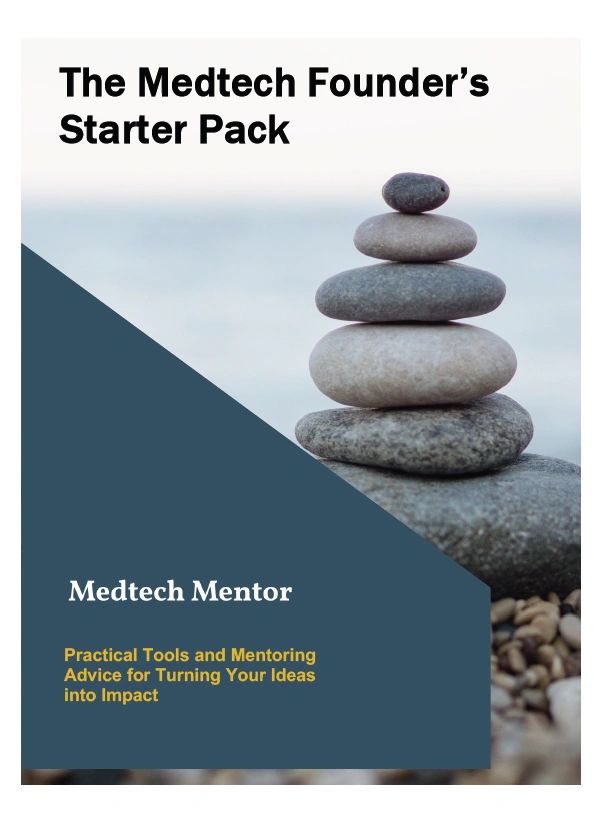
Sign up to our mailing list to receive our free Medtech Founder’s Starter Pack — full of templates, worksheets, and real-world advice to get you going.
Sign up using the form below for free access – you won’t regret it!!
Or check out our course From Idea to Business Model — a self-paced way to turn your idea into something fundable and real.
Ready to go from idea to impact? Let’s build something that matters.
— The Medtech Mentor Team